


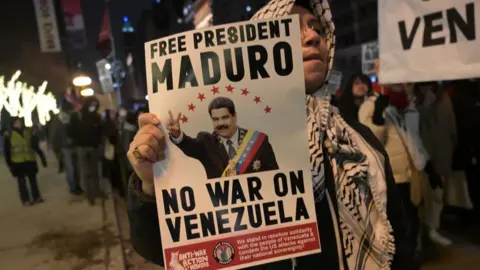
This past Monday, a handcuffed, jumpsuit-clad Nicholas Maduro exited a military helicopter in Manhattan, accompanied by armed federal agents.
The leader of Venezuela had remained in a infamous federal detention center in Brooklyn, before authorities transported him to a Manhattan courthouse to answer to criminal charges.
The Attorney General has asserted Maduro was taken to the US to "face justice".
But international law experts question the lawfulness of the government's maneuver, and argue the US may have breached global treaties governing the military intervention. Within the United States, however, the US's actions fall into a unclear legal territory that may nevertheless culminate in Maduro being tried, regardless of the methods that led to his presence.
The US maintains its actions were permissible under statute. The administration has charged Maduro of "drug-funded terrorism" and facilitating the movement of "massive quantities" of illicit drugs to the US.
"The entire team acted with utmost professionalism, firmly, and in complete adherence to US law and official guidelines," the Attorney General said in a official communication.
Maduro has consistently rejected US accusations that he oversees an narco-trafficking scheme, and in the courtroom in New York on Monday he stated his plea of not guilty.
Global Law and Action Concerns
Although the indictments are centered on drugs, the US prosecution of Maduro comes after years of censure of his rule of Venezuela from the United Nations and allies.
In 2020, UN inquiry officials said Maduro's government had committed "egregious violations" constituting human rights atrocities - and that the president and other senior figures were implicated. The US and some of its partners have also accused Maduro of manipulating votes, and refused to acknowledge him as the legitimate president.
Maduro's alleged links to drugs cartels are the focus of this legal case, yet the US procedures in bringing him to a US judge to face these counts are also under scrutiny.
Conducting a military operation in Venezuela and whisking Maduro out of the country under the cover of darkness was "a clear violation under the UN Charter," said a professor at a university.
Legal authorities pointed to a host of concerns raised by the US action.
The founding UN document prohibits members from threatening or using force against other states. It allows for "self-defense against an imminent armed attack" but that threat must be imminent, experts said. The other allowance occurs when the UN Security Council sanctions such an action, which the US lacked before it acted in Venezuela.
International law would view the narco-trafficking charges the US alleges against Maduro to be a law enforcement matter, authorities contend, not a act of war that might justify one country to take armed action against another.
In official remarks, the government has characterised the operation as, in the words of the Secretary of State, "primarily a police action", rather than an hostile military campaign.
Precedent and Domestic Legal Debate
Maduro has been indicted on illicit narcotics allegations in the US since 2020; the justice department has now issued a updated - or new - charging document against the Venezuelan leader. The executive branch essentially says it is now carrying it out.
"The operation was conducted to support an ongoing criminal prosecution linked to large-scale illicit drug trade and associated crimes that have spurred conflict, created regional instability, and contributed directly to the narcotics problem killing US citizens," the AG said in her remarks.
But since the mission, several jurists have said the US disregarded global norms by removing Maduro out of Venezuela unilaterally.
"A sovereign state cannot enter another independent state and apprehend citizens," said an expert on international criminal law. "If the US wants to apprehend someone in another country, the correct procedure to do that is a formal request."
Even if an defendant is accused in America, "America has no right to go around the world executing an legal summons in the jurisdiction of other independent nations," she said.
Maduro's legal team in the Manhattan courtroom on Monday said they would dispute the propriety of the US mission which brought him from Caracas to New York.
There's also a ongoing jurisprudential discussion about whether presidents must follow the UN Charter. The US Constitution regards treaties the country ratifies to be the "binding legal authority".
But there's a clear historic example of a previous government contending it did not have to observe the charter.
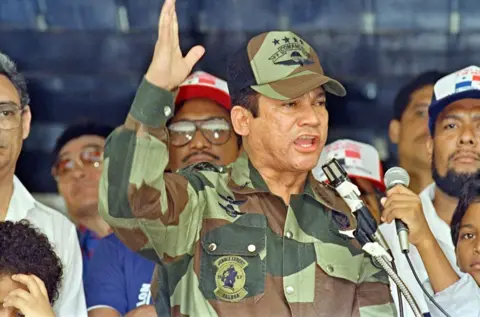
In 1989, the George HW Bush administration removed Panama's strongman Manuel Noriega and brought him to the US to face narco-trafficking indictments.
An internal legal opinion from the time argued that the president had the executive right to order the FBI to arrest individuals who flouted US law, "even if those actions contravene established global norms" - including the UN Charter.
The draftsman of that document, William Barr, became the US AG and brought the initial 2020 indictment against Maduro.
However, the opinion's reasoning later came under criticism from jurists. US courts have not directly ruled on the question.
Domestic Executive Authority and Jurisdiction
In the US, the issue of whether this mission transgressed any domestic laws is complicated.
The US Constitution vests Congress the power to commence hostilities, but makes the president in charge of the military.
A 1970s statute called the War Powers Resolution imposes constraints on the president's authority to use the military. It requires the president to inform Congress before deploying US troops overseas "in every possible instance," and notify Congress within 48 hours of deploying forces.
The administration did not provide Congress a prior warning before the action in Venezuela "due to operational security concerns," a cabinet member said.
However, several {presidents|commanders


